
How to Score 705+ on the GMAT
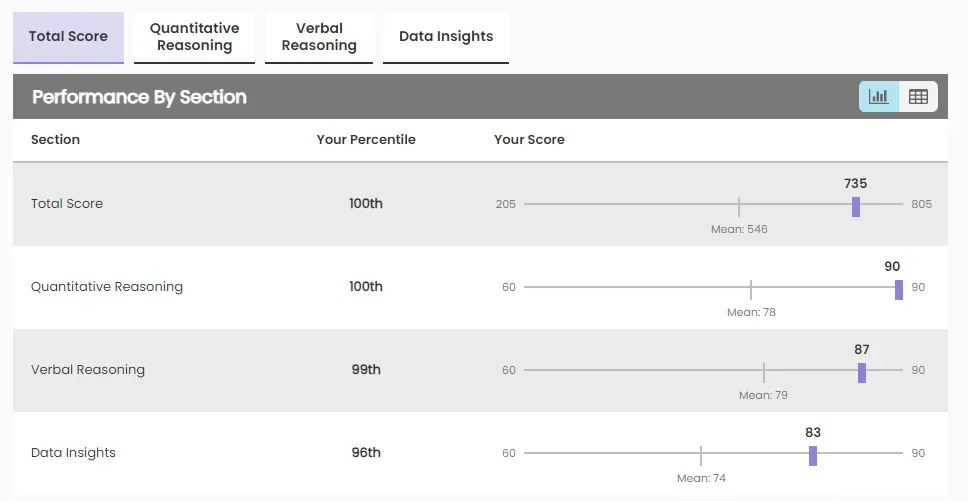
According to GMAC, the creator of the GMAT, 705+ scores are achieved by just two percent of test-takers, and 705 is significantly higher than any business school’s average. All the same, many GMAT aspirants want to know how to score 705+ on the GMAT.
There are multiple reasons why people want to score 705+. Among them is that scoring 705+ can help you stand out, get a scholarship, or offset a weak point in a profile. Also, some people even find shooting for 705+ a fun challenge.
So, in this article, I’m going to discuss how to score 705+ on the GMAT. I’ll cover everything from the number of correct answers needed to tips for achieving high accuracy and more. The ideas are based on what I’ve seen work for people, and much of what I’ll discuss applies to achieving any GMAT score. So, regardless of your target score, it can be part of your formula for success.
Let’s begin by considering the performance needed for scoring 705+.
The GMAT Performance Needed for Scoring 705+
Understanding what we have to accomplish to achieve a goal helps us to achieve it. Also, you may be wondering how hard it is to score 705+ on the GMAT. So, to get a sense of what it takes to score 705+, let’s see what level of performance we’ll need.
The Section Scores Needed for Scoring 705
To determine the section scores needed for scoring 705+ on the GMAT, we can use the formula for calculating GMAT total scores from 60 to 90 section scores:
So, we have the following:
So, since 255/3 = 85, we see that scoring 705 takes scoring an average of 85 on the three sections of the test.
KEY FACT:
Scoring 705+ on the GMAT requires scoring an average of at least 85 on the three sections of the test.
How Many Questions Correct to Score 705 on the GMAT?
From what I’ve seen, scoring 85 on each section of the GMAT generally takes getting around the following numbers of questions correct:
Quant: 18 - 20/21
Verbal: 20 - 21/23
Data Insights: 17 - 18/20
Adding up those numbers, we see that, to score 705+ on the GMAT, we must get at least around 55 - 58/64 questions on the test correct. And by the way, for an 85+ section score, any missed questions must be almost exclusively hard questions. Missing even a few easy or medium questions on a section can result in a score below 85.
Of course, Q85, V85, and DI85 is not the only combination of section scores that add up to 255, and thus produce a 705 total score. Still, getting any combination of section scores that add up to 255 requires getting around the same number of questions correct. So, to score 705 on the GMAT, we need to get around 86 percent of the questions correct.
(Note: It’s possible to score 85 with a correct answer count lower than the above ranges if some of your missed questions are among the uncounted experimental questions that appear on each section. So, you could score 85 with fewer correct answers by the luck of the draw.)
KEY FACT: Scoring 705+ on the GMAT takes getting at least around 86 percent of the questions correct.
Now that we have a sense of the performance needed for achieving a 705+ GMAT exam score, let’s discuss how to achieve that performance.
How to Prepare to Achieve 705+ Performance on the GMAT
We’ve seen that scoring 705+ on the GMAT takes getting a high percentage of the questions correct. Also, only 2 percent of test-takers score 705+. So, scoring 705+ is relatively challenging.
Accordingly, to score 705+, you have to prepare in especially effective ways. So, let’s now discuss my top GMAT tips for achieving such a score.
Tip 1: Master the GMAT One Topic at a Time
The most effective way to prepare for the GMAT is to work on one topic at a time. This study plan works best because, by focusing on one topic at a time, you can thoroughly consider the key aspects of each topic and really master the topics.
Mastering a topic involves the following three steps:
Study Concepts and Strategies: The first step in mastering a GMAT topic is to learn the concepts and strategies the topic involves. By learning the concepts and strategies, we build a foundation for mastering the topic.
For instance, to master Rates questions, we’d learn the rate formula and how to handle questions that involve catching up, combined rates, etc. For Weaken the Argument Critical Reasoning questions, we’d learn about the elements of arguments and strategies for identifying weakeners.
Practice Untimed: The second step in mastering a GMAT topic is to do practice questions involving the topic untimed.
People often think it’s best to do all GMAT practice timed. However, you’ll develop much stronger skills by doing your early practice of a topic untimed. So, don’t skip this key step.
When you practice untimed, shoot for two things: deep understanding and high accuracy. By shooting for those two things, you’ll develop super strong skills.
Also, when practicing untimed, you can work on finding ways to answer questions efficiently so that you’ll be able to answer them quickly later.
Speed Up: The final step in mastering a topic is to work on speeding up until you’re answering questions at test pace.
In doing so, you don’t have to go straight from practicing untimed to answering questions in the amount of time allotted by the test. Rather, you can incrementally reduce your time per question by looking for ways to be more efficient and pushing yourself to get to answers faster.
PRO TIP:
The most effective GMAT preparation method is to master one topic at a time by first learning concepts and strategies, then practicing untimed, and finally working on speeding up to test pace.
Tip 2: Learn GMAT Topics From the Ground Up
Another key aspect of preparing to score 705+ on test day is learning topics from the ground up. By learning a topic “from the ground up,” I mean going beyond memorizing concepts, formulas, and strategies to developing understanding of the topic’s logical foundations. In other words, it involves learning the hows and whys of the concepts, formulas, and strategies involved in the topic.
There are multiple benefits of learning topics this way. One is that you remember them better because your understanding of the logic of a topic supports your memory. Another is that you can apply what you’ve learned more flexibly because you understand how it works.
For example, let’s consider the permutation formula:
P(n,r) = n!/(n - r)!
Though that formula isn’t complex, it’s easy to forget exactly what it is over time or in the heat of taking the test. However, if you understand why each element of the formula exists, you’ll remember it more easily. In fact, if you have to, you’ll be able to derive the formula yourself when taking the GMAT.
Also, if you get why the formula works, you can apply the concepts underlying it in a variety of situations. For instance, if a GMAT Quant question asks how many ways there are to arrange people in different positions in a boat, the permutation formula may not fit the problem. However, if you get how the formula works, you can use the concepts that underlie it to solve out-of-the-box questions like that one.
And the value of learning topics this way doesn’t exist in Quant only. Learning this way helps in Verbal and Data Insights also.
PRO TIP: To maximize retention of and ability to apply what you learn for the GMAT, learn topics from the ground up.
Tip 3: When Practicing, Achieve High Accuracy and Long Streaks of Correct Answers
As we’ve seen, to score 705+, you have to get at least around 86 percent of the questions on the GMAT correct. In other words, you have to get close to 100 percent of any easy and medium questions and around 80 percent of any hard questions you see correct. To achieve such accuracies on test day, you need to achieve similar or higher accuracies when practicing.
Accordingly, as you prepare for GMAT Quant, Verbal, and Data Insights, shoot for the following accuracies:
Easy: close to 100%
Medium: 90 - 100%
Hard: at least 80%
What tends to work best for achieving high accuracy is to do one question at a time and check your answer after each question. That way, any time you miss a question, you can immediately identify what you have to do differently to get questions correct, such as read more carefully, use a method correctly, etc. Then, you can practice doing that in answering the questions that follow.
Also, to become super consistent and lock in a 705+ score, you can use the streaks method when practicing. The streaks method involves going beyond shooting for high accuracy to shooting for long streaks of correct answers.
If your score goal is 705+, it makes sense to shoot for streaks of 20 or more questions correct in a row. You could shoot for streaks of 20+ in topics or in difficulty levels within topics. Alternatively, you could shoot for streaks of questions in general categories such as easy Reading Comprehension questions or hard Official Guide Quant questions. I discuss this approach in detail in this post on the streaks method.
PRO TIP:
A key aspect of scoring 705+ on the GMAT is achieving high accuracy and long streaks when doing practice questions.
Tip 4: Answer Quant Practice Questions Using Multiple Approaches
To a large extent, the GMAT is a test of skill in getting things done. One way the GMAT tests that skill is by presenting Quant questions designed to test it. In other words, GMAT Quant questions don’t test just math skills. They test our ability to see what’s going on in a question and come up with a way to answer it.
For example, a word problem may not be solvable with algebra alone. Once we’ve done the math involved, we may need to use logic to determine which answer choice fits certain constraints mentioned in the question stem.
Accordingly, we’ll be better positioned to score high on GMAT Quant if we actively develop skill in coming up with ways to get things done.
One way to do so is by answering Quant practice questions in multiple ways. For instance, we could solve a word problem first by using algebra, then by using smart numbers, and finally by working backward from the answer choices. Or we could answer a Probability question first by using fractions and then by using combinatorics.
Also, if you aren’t sure how to solve a question, rather than quickly go to the explanation, you can stick with the question and come up with a way to answer it. Even if the way you come up with isn’t elegant or efficient, you’ll have practiced coming up with something that gets you to the answer.
By practicing in these ways, we can become adept in finding ways to answer Quant questions on the fly and confident that we can answer any Quant question the GMAT might throw at us.
PRO TIP:
To develop skill in coming up with a way to answer any Quant question you see, answer Quant practice questions in multiple ways.
Tip 5: In Answering Verbal Questions, Use Sophisticated Thinking
As we saw earlier, to score 705+ on the GMAT, you need to get the vast majority of the Quant, Verbal, and Data Insights questions correct. What that means with regard to Verbal specifically is that you have to get correct not only easy and medium questions but also most of the hard questions. So, here’s the thing.
You can get easy and some medium Verbal questions correct using relatively simple thinking or even gimmicks in some cases. However, to get hard GMAT Verbal questions correct, you have to use relatively sophisticated thinking. In other words, you have to pick up on subtle logical implications of statements and make non obvious connections between facts or ideas. So, to score 705+ on the GMAT, you need to learn to use sophisticated thinking in answering Verbal questions.
To learn to use that type of thinking, practice answering Verbal questions untimed. As you practice, make sure you fully understand the passages, and carefully analyze each answer choice of the questions. Notice how each answer choice is related to what the passage says or affects the scenario presented.
For more detail on using sophisticated thinking in answering Verbal questions, see my post on how to master GMAT Verbal.
PRO TIP:
To a large extent, your GMAT Verbal section score will reflect the level of sophistication of the thinking you use in answering the questions.
Tip 6: Focus on Execution to Score High on Data Insights
This last tip applies to all parts of the GMAT but perhaps especially to Data Insights, and the tip is to work on executing flawlessly.
In Data Insights, we’re flooded with information and opportunities to make errors by mixing things up, by missing key details, or in some other way. For one thing, to get some Data Insights questions correct, we have to identify, not one, but three correct answers. Also, in many cases, we have to assemble multiple pieces of information and take multiple steps to arrive at a correct answer. Accordingly, to master Data Insights and get all or close to all the DI questions correct, as we must to score 705+, we have to learn to execute virtually flawlessly.
So, when practicing Data Insights, be super careful to get little things right, by doing things like making sure you’re answering the question asked and reading choices in their entirety. Also, when dealing with information in graphs or tables, make sure you have labels straight, are looking at the right part of a graph or table, and in general are getting the right information to answer the question. When answering Multi-Source reasoning questions, take the necessary steps methodically and using care in each step.
You might be amazed at how much of a difference how carefully you execute can make. To a large degree, your Data Insights score will reflect simply how good you are at completing multiple steps without making a mistake.
PRO TIP:
To score high on the Data Insights section, focus on learning to execute virtually flawlessly.
Tip 7: Cultivate a Winning Mentality
Since our mentality is at the foundation of our GMAT performance, my final tip for GMAT success is to cultivate a winning mentality. For stellar performance on the GMAT, we can cultivate a mentality with the following aspects.
A Growth Mindset
Having a growth mindset involves believing that you can develop your fundamental abilities and strengthen skills that are weak. So, of course, a growth mindset is essential for GMAT success since GMAT prep is a form of self-development.
With a growth mindset, we can see weaknesses as temporary, skills that we don’t have as skills that we will have, and a high GMAT score as the logical result of effective preparation.
To develop a growth mindset, you can remind yourself of how you have developed skills in the past, notice how others have been able to develop themselves, and understand that all of us have unlimited potential.
Attention to Detail and Thoroughness
Another key aspect of a GMAT success mentality is attention to detail and thoroughness.
Attention to detail and thoroughness are important in all aspects of GMAT preparation, from how we choose resources to how we handle each step of answering a question. In fact, I’ve seen people’s GMAT scores soar as a result of their simply deciding to be more detail oriented and thorough.
A Positive, Glass-Half-Full Attitude
Finally, a positive, glass-half-full type attitude can make a big difference in our GMAT journeys.
For one thing, having a positive attitude can help us overcome setbacks and keep going if things get tough.
Furthermore, a positive attitude can make day-to-day GMAT preparation more enjoyable. With a positive attitude, minor issues remain minor, little wins can be celebrated, and we focus on the positive aspects of what we’re doing.
A positive attitude can even help us perform at our best on test day since it will help us press on when we find a question challenging and reduce stress by lightening our mood.
PRO TIP:
Key to scoring high on the GMAT is cultivating a mentality characterized by a growth mindset, attention to detail and thoroughness, and a positive attitude.
Having gained insights into how to achieve a top GMAT Score, let’s now discuss what to do if your progress stalls along the way to 705+.
How to Break Out if Your Score Plateaus on the Way to 705+
One issue that many GMAT aspirants experience on the way to their goals is that their performance plateaus. In other words, although they continue to prepare, their practice accuracies or scores stop increasing.
Often, people whose GMAT performance plateaus have the impression that they’ve hit “score ceilings.” In other words, they think that they have hit some kind of natural limit above which their scores won’t go. However, the truth is that the idea of a score ceiling doesn’t really make sense. What makes sense is that, if you keep preparing effectively and developing yourself, your GMAT score will continue to increase.
So, what’s going on if your GMAT performance plateaus is not that you’ve hit a limit in your abilities. It’s that how you’re preparing has hit a limit to how far it can take you. Accordingly, to break out if your score plateaus, you have to change how you’re preparing.
So, one thing you can do to get your performance to start improving again is to adjust how you’re preparing. For example, maybe you need to learn concepts more thoroughly, practice weaker topics more extensively, or make better use of your error log.
Alternatively, you may need to try something new. For instance, you could try a new practice method or a new course. You could learn new strategies for answering questions. It might make sense to do some sessions with a tutor. Or maybe doing some meditation, visualization, or inner work will get your score to start increasing again.
Keep Finding New Levers to Pull
In general, to get your score to start increasing again, keep finding new levers to pull. Do some research. Ask others what has worked for them. Experiment. Keep trying one thing after another until something works.
PRO TIP:
To break out of a score plateau, make adjustments or additions to your preparation approach until you find something that works.
Now, you may be wondering how long it will take you to get to 705+. So, let’s cover that before we finish.
How Long Does It Take to Get to 705+ on the GMAT?
Each GMAT aspirant has a different starting level and different things to accomplish to get to 705+. So, it’s tough to accurately predict how long or how many hours of study you’ll need to score 705+ on the GMAT.
Still, we can estimate how long you’ll need to prepare by considering your current level. So, if you’ve taken a practice test or the actual GMAT and thus have a starting score, the amount of preparation time you’ll need to get to 705+ is likely along the lines of the following:
Starting score around 605: You’ll probably need around 2 to 3 months, or 150 to 250 hours, to get to 705+.
Starting score between 505 and 555: You’ll probably need around 4 to 6 months, or 300 to 500 hours, to get to 705+.
Starting score below 505: You’ll likely need 6 months or more to get to 705+.
PRO TIP:
To get a sense of how long you’ll need to prepare to get to 705+, use your current score level to make an estimate.
Let’s now wrap up with the takeaways from what we’ve discussed.
How to Score 705+ on the GMAT: Key Takeaways
Here’s what we’ve seen we can do to score 705 or higher on the GMAT:
-
Shoot for getting at least 55 - 58/64, or around 86 percent, of the questions on the test correct.
-
Master one topic at a time by first studying concepts and strategies involved in a topic, next practicing answering questions involving the topic untimed, and finally speeding up to test pace.
-
Achieve high accuracy and long streaks of correct answers when practicing.
-
Develop skill in coming up with ways to answer Quant questions by answering Quant practice questions in multiple ways.
-
Learn to use sophisticated thinking to get hard Verbal questions correct.
-
Focus on executing flawlessly to master Data Insights.
-
Cultivate a mentality characterized by a growth mindset, attention to detail and thoroughness, and a positive attitude.
-
Adjust or add to preparation approaches if necessary to continue making progress.
And finally, perhaps the most important takeaways from everything we’ve discussed are that you need to prepare in especially effective ways to score 705+ and that a 705+ score is achievable because effective preparation works.
Want help putting this into practice?
I work one-on-one with test-takers to turn strategies like these into real score gains. Send me a message and I'll build a plan tailored to you.
Send me a message